Pride and Prejudice – A Lamentation for Black History Month

I just published an article over at Forth District. Take a look at it over there, I love what those guys are doing with their conversations on arts and culture. Post visible at:

http://forthdistrict.com/pride-and-prejudice-a-lamentation-blackhistorymonth/

Awakening to Gender Privilege

A few things have been happening lately, from Hillary being called out for her shouting while Bernie screams continuously, to people scheduling a multi-city rape advocacy parade in freaking 2016, to an ongoing cavalcade of foolishness regarding women and every damn thing that they do. I watch all this go on, and I just start to feel like:
8tllwmw
Race has been an issue for about 400-500 years. Gender has been an issue for at least a few thousand in most parts of the world. It’s so much more deeply rooted that it feels natural in a way race never quite does. To be honest, there is a biological component. Men and women are built differently, and process the world differently. Men and women also need each other in a way that two random people from different parts of the Earth don’t. I’m not an advocate for an equality that doesn’t recognize our differences, any more than I am an advocate for a racial equality that doesn’t recognize and allow for cultural diversity. But I am not an advocate for a system that has women as lesser either, or doesn’t allow for individual women to break a pattern that doesn’t make sense for them.
Historically, I would have described myself as pro-women, and that was mostly true. I didn’t believe in restricting women’s freedoms. I thought their underrepresentation in positions of power was wrong. I also would say I was aware that being a male conferred me certain advantages in our society. I wasn’t blind to the notion of privilege; on the contrary, I used it to better help me understand what it might be like to be on the upside of racial privilege.
But was I anti-sexism? When I saw weirdly sexy ads for hamburgers, did I roll my eyes or give a Beavis and Butthead chuckle? When an attractive woman walked by at work, did I remind myself that she was a colleague, client, or hell, supervisor, or did I just check her out? And in the latter case, how did that affect how I dealt with her in business?
I think about this more now that I’m older and differentially wiser. If I’m mentoring or leading a woman that I’m attracted to, even though I’m happily married and have no intentions of making anything of it, how can I do my job effectively? I have to take extra precautions to ensure fairness. I have to watch my mouth around my peers, and call my peers out in a way that feels unnatural and weak. And how far do I have to go, exactly, to ensure I’m creating a climate that neither feeds nor tolerates sexist behavior? The end result can be a kind of secular asceticism which is both frustrating and difficult to maintain.
It’s not about my desires and challenges, ultimately. As a man, the entire framework is built to accommodate my desires. Nothing is more difficult than speaking truth to power and demanding fair treatment with no protection from those same systems of power. That said, it’s time for me to engage in the second most difficult kind of work: dismantling the platform of advantage I am standing on.

Unpacking Black Lives Matter – a response to “Exposing Black Lives Matter”

A Christian friend of mine recently posted this article by a black minister, Rev. Dr. Eric Wallace, critiquing the organized portion of the Black Lives Matter movement. (I’d encourage you to read the article first to understand the full context of this post.) He asked for thoughts from his black friends. So I sat with it, read it, and came up with several thoughts that started as a Facebook comment but that I thought might better be served as a blog response. I had several issues with the article, which I outline below.

  • The author uses several words and phrases to inflame the conversation and discredit the beliefs of the BLM leadership. He brings up the Marxism of some of the black liberation movements to tie that to BLM when there is no explicitly Marxist or atheist platform espoused. He also quietly mentions that one of the founders is the child of illegal immigrants, when illegal immigration is neither part of the platform nor part of the counterargument. The worst, in my opinion, is when he says: “According to BLM, “black liberation” can be achieved only by reversing the roles of master and slave.” This plays on longstanding white fears that what protesting black people really want is to make them hurt the way that white people hurt their ancestors not so long ago. I know the author is black, but he’s bought in to the belief in zero-sum protest: that black people can only demand gains in this way at the expense of someone else’s freedom and liberty. I reject this belief, and believe instead in one of BLM’s strongest platform points: “When Black people get free, we all get free.” When we liberate the most oppressed people in our society (probably poor black trans women at this point), we’ve undone the chains that bind every part of that equation, and in the process have undone the chains that many of us wear as oppressors as well.
  • I think the author overplays his hand regarding Planned Parenthood. As I mentioned earlier, I don’t buy the “PP is secretly out to eliminate black folks, just like Sanger wanted” angle that people keep pushing. How many poor (and in a country with no public health care, not so poor) black women have benefited from the women’s health and birth control services PP has provided? We can’t have a conversation about PP without looking at both sides of the scale. That doesn’t negate the problematic nature of abortion, but abortion deserves its own discussion platform rather being used as a argumentative daisy cutter that just wipes out all validity of the opposition.
  • As to liberal versus conservative views on the role of racial discrimination versus government intervention in progress, we simply disagree. I think there has been some cynicism in liberal policy, and I think one of the best things about BLM is that it isn’t beholden to either political axis, so they are just as willing to challenge liberals as conservatives. However, I think it’s unfair and also concerning to say that government largesse is why black people aren’t moving ahead at the rate we all think should be happening. It implies in particular that there’s substantial government aid being given to black people that is making them lazy. At least one article recently written in the Washington Post looks at the condition of things in places in the South where aid programs have been severely cut. This article describes a situation where people are diligently seeking work and cannot find it right here in Atlanta, and where less than 1% of income-eligible citizens are receiving full welfare benefits. With all the hand-wringing among conservatives about how much we spend on the undeserving, you’d think half the city was cashing government checks on the first of the month.
    I’m not saying that we shouldn’t look at programs and measure them to see if they’re working. We should. I’m also not saying that race is the only piece of the puzzle. But with a refusal to consider race as a meaningful part, some things in the puzzle don’t make sense.
  • It is fair to note that BLM is not a biblical or Christian movement. As such, why are we concerned about them affirming the right of LGBTQ+ people to exist free from harm? That affirmation is by definition earthly, and concerned with justice, not asking you to believe they will enter the kingdom of Heaven. On the spiritual side of sexual/gender identity issues, a conservative Christian has no more dispute with BLM than they do with any fully affirming sect of Christianity. Bringing a spiritual discussion about the fate of souls who live that out to the table is a distraction from the question of whether the movement should be concerned with earthly justice for them.
  • The BlackLivesMatter/AllLivesMatter false dichotomy is a copout. Again, it returns to this zero-sum thinking, where either BlackLivesMatter or AllLivesMatter, but not both. As I said before, if you want to be critical of where the movement isn’t doing enough in your opinion, that’s fine, but don’t use the movement’s weaknesses to negate their valid points.
  • Lastly, as I’ve probably said before as well, I’m sick of “black-on-black crime” being brought up as a thing. Black on black crime is not a special kind of crime, due to a special kind of pathology in a special kind of people. It’s what crime looks like in the black part of a segregated society that has historically explicitly impoverished black people. You fight with, steal from, and kill your neighbor generally, and you do more of that when you’re broke. Now, we can and should address violent crime in poor black neighborhoods, and contrary to many conservative pundits’ beliefs, there are people and organizations doing that every day. But when we relegate it to black-on-black crime, we do two things. First, we add to this notion of a special black pathology. Second, for those of us that consciously or subconsciously view blackness as “other”, when we call it “black-on-black crime” and not just “crime”, we make it someone else’s problem.

I would like to see conservatives continue to critique and challenge liberal points of view, as that diversity in dialogue is essential to our long-term societal health. However, I think this can be done in a way that validates the truths being spoken instead of just using the weaknesses or holes found to invalidate the truths.

Sin Substitution – A Useful Technique

This post goes out mostly to my Christian friends, as evidenced by the title. If you’re not Christian, don’t tune out though. . . there may be something useful in here for you if there’s something you do that you’re not happy about and would like to change. Please don’t let the religious terminology cause you to miss something that might help you be a more compassionate and joyful person.

I was talking to a good friend of mine, Rudi, about a problem we were seeing that was being dismissed. It’s not the type of thing you’d typically get up in arms about.  He jokingly said, “well, I’ve got this woman on the side, but no big deal, God understands me.” The implication was that we wouldn’t casually commit adultery and assume it’s a sin that God would shrug and go “oh well, you’re just weak, I get it, it’s cool bro.” So why do we make that assumption about other sin?

Sexual sin gets us, well, all hot and bothered. It’s easy to identify and point out, even if we don’t all agree on what constitutes an actual sin. Some of the no-brainers like murder and theft, we all agree are wrong; it’s easy to identify unjust taking of life or property. But what about those secret, soft sins? What about how jealous we are of our friend for whom everything seems to come so easily? Or how reliant we are on money for our sense of self-worth? Or how unwilling we are to listen when someone is lovingly correcting us, because we know we thought this through and have to be right?

One of the most helpful things my church taught me was a fresh perspective on idolatry. We tend to think of only the most extreme cases when we’re thinking about idolatry; people like the junkie who lost everything, or the slave to lust who blew up his or her marriage. But how many times have external factors in the world changed our emotions and claimed our focus? We wring our hands, weep, and fret over that relationship we couldn’t have or that isn’t going as well as we would like. We rack our brains to come up with a way to make a little more money so we can feel safe. We are raising our love or our money in these situations as idols with the power to determine our joy or take it away. Another perspective, taught to me by a church a while back, was that the definition of worship is what claims your time. Again, in these situations, our energy is not focused on what God’s will might be for us, but on what these things can do for us.

A useful technique to evaluate whether you’re being dismissive of your sin is to perform one of these substitutions. Take your problem that you don’t find abhorrent, but that you feel in your conscience is wrong, and substitute it with one that you do find abhorrent. Most of us wouldn’t feel comfortable stealing a car from a parking lot, for instance. So pretend instead that instead of chasing money, or worshipping a guy, you were stealing cars and couldn’t stop. What do you think God would have to say to you about that sin then, if you were to ask? What do you think your conscience would say to you? And how serious would you be about fixing it? When you’ve got a good handle on the feeling of conviction, and your feeling about how earnestly you’d like to change if you were that person, keep those feelings and apply them to the current situation.

A non-Christian objection to this notion of sin is that it’s a cosmic guilt trip. I view it a bit differently. One of the things that I find most interesting about Christianity is that everything works in reverse. We don’t fight our human nature and act good so that we can gain the favor of God and be spared wrath. Rather, because we believe a triune God sent a part down as a human to pay the debt we had accrued for past, present, and future wrongs, we fight our human nature that just wants to rack up more debt and serve ourselves and instead seek to know, reconcile, and ultimately be united with this being.

This is why Christians prefer to seek conviction over guilt. Conviction tells you something is wrong, just like guilt does. Guilt, however, carries a seed of wrath; you are either planning on punishing yourself or awaiting external judgment. Conviction carries a seed of forgiveness; as we turn back to God and renew our commitment, we receive the forgiveness that permeates the entire universe and binds its brokenness. I use “receive the forgiveness” rather than “we are forgiven” because it’s easy to confuse the latter with “we’re forgiven because we repent, conditionally”. Forgiveness sits in God’s open hand, and it’s on us to take it and choose its joy and consequence. Of course, we can choose not to take it, but that’s not denied forgiveness; that’s rejected forgiveness, rejected by us.

Oddly, I feel compelled to answer the obvious question my title engenders at the very end: what is sin? I’ve been taught and believe that sin is that which separates us from God, or is anything that we place above God in priority. However, what if your understanding of God is different, or you are currently having trouble believing that there is a God at all? If you’re currently in that place, I think it’s useful to think of sin as something that causes us to choose ourselves over others, or to choose a short-term victory over a long-term one that we know we could have if we persevered. Sure, there are edge cases, but exploring at the margins doesn’t help us get to the center of a truth; it merely tests the limits of that truth. The center is where we wish to be for now, so ask yourself: where am I choosing my desires over the legitimate needs of others? Where am I chasing a short-term win that is destroying my long-term prospects? Then, try swapping that problem with a more serious and urgent one and see where it gets you.

My Social Media Filter Guidelines

I spend far too much time on Facebook, like at least 100 million other people I don’t know. Processing that much information is a challenge. Fortunately, Facebook puts the site name in all caps in gray below any post. I’d like to share some of the techniques I use to determine what is newsworthy:

economist.com, nytimes.com – Unbiased or biases will be obvious. Read it.

theguardian.com – This is really important and will never, ever be reported in the US. Read it.

cracked.com – It will be funny and ridiculously stated but true. Read it.

foxnews.com – It’s Obama’s fault. Skip it.

tiny.iavian.net, theblaze.net – It’s liberals’ fault. Skip it. (I guess you could skim The Blaze if you’re conservative or want some balance)

breitbart.net – Obama is the Manchurian Candidate. He’ll invite Yemeni religious zealots in to impose Sharia and steal your daughters. Skip it.

salon.com – It’s the conservatives’ fault. Skip it unless you are a liberal that is feeling super partisan and want to co-sign that day.

thinkprogress.org, dailykos.com – It’s the conservatives’ fault, but here’s why. . . Skim it.

forbes.com – Rich liberals argue with rich conservatives. Read it to see how rich people think.

mostlocalorregionalpapers.com – If you live there or the event you’re reading about happened there, read it. Otherwise, it’s probably a bad opinion piece. Skip it.

theonion.com – It’ll be funny, but the headline is usually the joke. Read the headline, read the article if you’re trying to burn some time.

openyourmind.net, countercurrentnews.com, anythingthatsoundslikethat.com – It sounds awesome, but there’s absolutely no science behind it. Skip it, or at least check Snopes.

huffingtonpost.com – Could be celebrity dish, could be politics, could be defining issues of our time. Who knows? Probably skip it.

I hope this helps!

Reversal of Fortune


I once held everything in thrall.
They came, and took, and gave to you.
My finest things you don’t deserve —
I knew exactly what to do.

I carefully mixed the poison down,
distilled it, raised its potency.
I placed the poison in your drink
so stealthily, you did not see.

It looked so lovely, boiling there.
Your glass, a fine cauldron it made.
I reveled in the fantasy
of seeing the headstone at your grave.

I poured myself another glass
to reassure naught was amiss.
My toast and smile would dull the blow,
and blunt my poison’s deadly kiss.

And as I drank so deeply from
the glass I’d poured, my bitter wine,
I clutched my chest and realized
the drink that I’d poisoned was mine.

-C. G. Brown

The Lottery

I’ve seen a lot of instances of the past few years of lives being changed by funding sites like KickStarter and GoFundMe. We all know the pattern. A person’s story has some element in it that tugs at the heartstrings, or ignites the imagination. The story goes viral on social media. Donations begin pouring in. Before you know it, a life is changed. It’s like winning the lottery.

As we know, lotteries are often bad for the people that win them. The tidal wave of money crashes against the seawall of old habits, behaviors, and self-imposed limitations.  Newfound gains are spent on expensive trifles to treat ourselves. Relatives and friends we haven’t seen in years (or at all) come pouring in, hoping to gain something for their “unwavering support” through the years. Underneath it all, the winner may feel that they don’t deserve this money, or they are too afraid of what an unknown life of riches looks like when put up against a known life of lack. The money is gone, or the money stays, and no one is happier for long.

There’s another, bigger problem with this lottery mentality when it comes to giving. When we give a few dollars to some needy homeless father or to a man walking for miles every day to work because he can’t afford a car, we are quite pleased with ourselves. We’ve helped someone out. We’ve done some good in the world. And then we forget about the millions of other people with the exact same story, or worse, who weren’t lucky enough to be discovered, or charismatic enough to spin a compelling tale of woe.

When a society pays taxes and votes to allow social services, the goal is to ensure that all citizens in hardship get some support. As more of us clamor for lower taxes and less government intrusion, we focus our giving on individuals and our whims, instead of taking the risk that government might waste some money or give some to someone who didn’t deserve it, such as the infamous welfare and food stamp boogeymen waiting to turn your tax dollars into lap dances, cigarettes, and beer. (Of course, we never talk about the real defense companies that turn many more of your tax dollars into failed weapons projects.) We’re not satisfied with the rain falling on the just and the unjust alike. We want to make sure the undeserving get good and soaked, at least until they pick themselves up and meet our standards.

I believe the free market is best for distributing things that have a tangible, transparent, and immediate value. It doesn’t make sense for government to run retail stores, for instance, when the market is perfectly good at setting prices. However, for intangible value, or value that is a long-term return on investment like the interstate system or public education, the government can make a credible case at being the most efficient provider due to its economies of scale and ability to distribute the load across the entire citizenry instead of a limited consumer base.

By all means, give to the causes that speak to your heart.  Just be mindful of this social media fueled lottery mentality that, when combined with our increasing tightfistedness when it comes to government-allocated resources, is causing us to leave too many to fend for themselves.

The “Genderqueer God” and the Affirmation of Identity

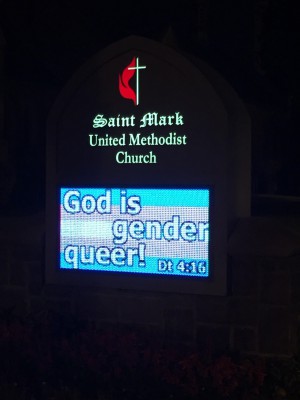
Here in Atlanta, it’s Pride weekend, where LGBTIQ (and imagine A as well in a few cases) people and their allies celebrate the freedom to define themselves and their identity. While walking in Midtown this Friday, I passed St. Mark’s United Methodist Church. They had an electronic sign in the front posting messages about services as well as affirming messages such as “you are a child of God and you are welcome here.”  One message gave me pause, and it was this:
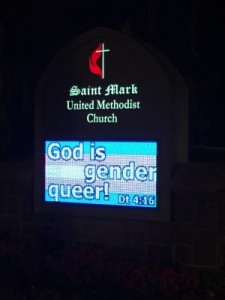
Sign reading

My personal theology is evolving, but is fairly liberal. I am pretty comfortable with “live and let live” with respect to people’s personal identities, and am staunchly in favor of civil liberties for all people regardless of orientation or identity. However, this made me angry to read in a way that I didn’t expect. Intuitively, it felt like a willful misinterpretation of Christian beliefs as stated in the Bible. Since I consider myself fairly liberally-minded, having what I viewed as a conservative reaction bothered me. I decided to do some research and reflection rather than assuming that the statement was wrong or accepting it on its face.

First, we should define the term “genderqueer”. Wikipedia defines it as:

“a catch-all category for gender identities that are not exclusively masculine or feminine—identities which are thus outside of the gender binary and cisnormativity.”

For those just joining the bleeding edge of identity concepts, cisnormativity refers to the bias toward a understanding of the world where men identify only as men and women identify only as women.

Given this definition, at first, the statement sounds a little less crazy. God is not defined as male or female and does not conform to the gender binary. We refer to God as male because we grew up in (and the books of the Bible were all written in the context of) a patriarchal society. I actually would rather refer to God using the pronoun “it”, but that word is loaded with problematic nuance that doesn’t work in English. Does this mean that we can refer to God, then, as “genderqueer” and have that be as accurate as saying “God is not male or female”? I’ll get to that in a minute.

The verse referred to in the image, is Deuteronomy 4:16, which reads:

“beware lest you act corruptly by making a carved image for yourselves, in the form of any figure, the likeness of male or female”

I’m not sure what this verse has to do with the assertion that God is genderqueer. As far as I can tell, this is a restatement of “don’t make graven images”, which is part of God’s drawing of a distinction between the Hebrews and the other people of the area, who worshipped multiple gods and viewed idols as focal points for worship. I get that it’s asserting that God’s likeness can’t be captured as male or female, but it goes on in the next verse to say you can’t use animals either. So let’s look at a verse that has some more relevance; Genesis 1:27:

“So God created man in his own image,
in the image of God he created him;
male and female he created them.”

So if man and woman are both created in the image of God, this would mean that the image of God encompasses both masculinity and femininity. More evidence that God does not conform to the gender binary. So we ask again, does this make God “genderqueer”?

I’m not a minister, and not even particularly well read on theology and religion, so I welcome thoughtful insight and counterpoints from pastors and ministers out there on this. However, one key theological tenet that I have taken to heart is that one cannot submit the Creator of the entire universe to the Creation that was made. When we define God as an old white man (or even just as a man), we are reducing God to conform to the rules of that creation. However, by the same token, if we try to box God into any characteristic of human identity, we’re doing the same thing; conforming God to the creation made by God.

God does not have a gender; God created gender, and created each person that subscribes to a particular gender identity as well. The irony of using that part of Deuteronomy to justify the assertion that God has a particular gender identity that is affirming to the non-standard binary is that in making that assertion, we are creating a different kind of “graven image”. We are trying to fit God into our understanding of how things should be so that we can comprehend, and be more comfortable, and have God accept us.

This is where the beauty of the Christian understanding of grace comes in. Those who believe in this believe that God created each of us the way we are, complete with our strengths and weaknesses. We don’t need to reduce God to make God accept us where we are today. Now, once we take God’s proverbially outstretched hand, Christians differ on what outworkings there may be on that based on your gender identity and sexual orientation. Some believe that having a non-standard identity or orientation means that you must live with it without changing it or acting on it. Others believe that there are paths for everyone to experience the fullness of earthly love, partnership, and self-definition in a way that is not offensive to God and in line with each person’s identity and orientation. Picking a side there is a bit beyond the scope of this article. Ultimately, though, if our affirmation is in an acceptance of the grace outlined in the Gospel, we don’t need a God that looks like us and behaves like us to be validated and affirmed.

Catechism

Rorschach pools gather again.
We look outside, breath condensing at the window
as we fervently seek to find The Stranger, our adversary.
We double-lock our doors
as the slate-gray burn singes our nostrils.
At our feet, casings for rosary beads.
We kneel, and bow, and recite our catechism.

“Hail Pistol, full of protection
I need no one but you with me.
Blessed are you among weapons,
and blessed be the fruit of your womb, Bullet.
Holy Pistol, mother of Safety,
cover our weaknesses and fears now
and ward the hour of our death.”

This god does not hear the thump of flesh on concrete,
cannot smell acrid, sweating fear as the lambs run,
cannot taste the blood you feed it.
We look outside, seeking The Stranger,
while those we keep, coddle, then ignore
creep at our backs, mouthing prayers
to a senseless god, and reloading.

-C. G. Brown

Dedicated to far too many.

Until We’re All Free

I’ve been thinking a lot over the past couple of years about what constitutes racial reconciliation, and what needs to happen to bring us together. In that process, though, I have found something else under the hood which is more troubling. Our society is deeply, fundamentally misogynistic. I know this doesn’t come as a revelation to many of you. It is obvious to the casual objective observer. What’s not obvious is how much it matters. Because we refuse to face how deeply disregard and hatred of women is embedded in our interaction, we’re having an incomplete conversation, laced with hypocrisy.

I hear it in hip-hop and rock-and-roll (let’s not focus on the rappers alone), where women are prop, scorecard, something to use and discard. I hear it in politics and acting, where women are asked about their families, emotions, and fashion while men are asked substantive questions about the issues or their craft. Our misogyny even informs our interaction with LGBTIQ issues. Through this lens of misogyny, a lesbian is just a confused woman who hasn’t met me yet, and who hopefully will bring her partner along to run up my score once she comes around to my way of thinking. A gay man is disgusting because he’s seen as being so much like a woman (and who in their right mind would give manliness up?). A transgender F-to-M is a child in a grown man’s shoes, playing at manhood. A transgender M-to-F is the ultimate deception.

We are trying to understand a three-dimensional cube by looking at lines and squares. Intersectional understanding is predicated on the notion that our system of interaction has unequal inputs and we should have conversations about how to ensure just (not necessarily equal) outcomes. We can’t evaluate the problems being black causes completely separately from the problems being a woman or being poor causes; they feed into each other and amplify each other.

We also know that oppression traps the oppressor as much as the oppressed, though the oppressed suffers more. Men live daily with the limitations placed on them by patriarchal notions of manhood. We can’t cry (except maybe when our sportsball team loses). We can’t be gentle and soft. We are only given anger, stoicism and strength as blunt instruments to deal with everything. What happens when we give a man a full range of healthy tools to become who he needs to be?

Each time we free a segment of society, tremendous potential is unleashed. Much of the creativity and innovation of the 20th century came from people who would have been stifled and lost a century earlier. How much business and technical innovation did we miss because of our rules? What are we still missing as technology booms and is conspicuously missing the contributions of women, black, and Latino people in proportion to their societal presence? Considering that women are half our population, how much potential are we missing by not giving them space to be their fullest selves?